
✓
Trusted by 40% of Fortune 1000
Uncover Hidden Risk With Credit Risk Management Software
The CreditRiskMonitor® web-based credit risk management platform helps credit, finance, treasury and risk professionals identify financial distress and bankruptcies before they lead to bad debt. By continuously monitoring customers, our actionable insights help you reduce risk, protect cash flow and make informed credit and collection decisions.
Clarity that drives better credit decisions
Knowing which customers require immediate attention allows your team to prioritize risk, set appropriate credit limits and confidently pursue new business opportunities.
Our leading credit risk management software combines proprietary analytics, trusted third-party data and expert financial analysis to deliver the industry’s clearest views of business financial health — including bankruptcy predictions up to 12 months in advance.
Our leading credit risk management software combines proprietary analytics, trusted third-party data and expert financial analysis to deliver the industry’s clearest views of business financial health — including bankruptcy predictions up to 12 months in advance.
90
Satisfied clients
0
of Fortune 1000 served
1
global trade payments annually






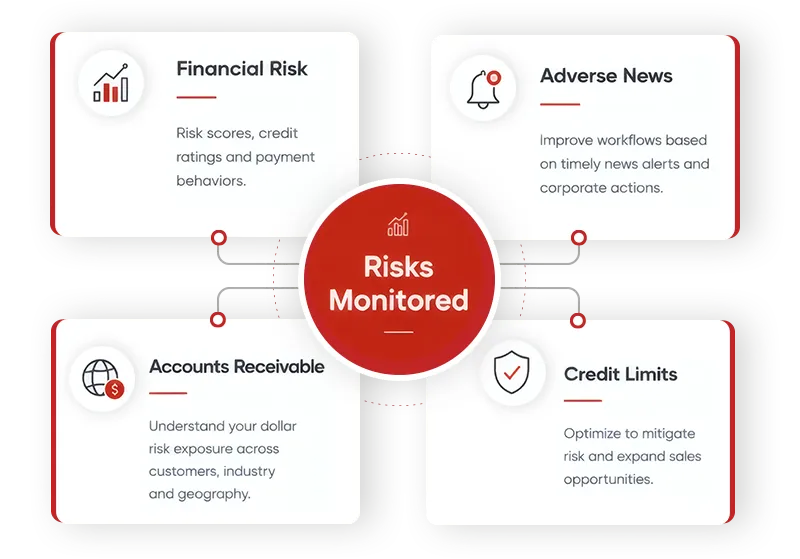
Types of risk monitored by credit risk management software.
Identify risk early to take action
CreditRiskMonitor® delivers the visibility, analytics and early warning intelligence your credit team needs to identify risk sooner, minimize losses and make faster, more informed, consistent credit decisions. The continuous monitoring you get from CreditRiskMonitor® can reduce your bad debt exposure by 20-30%.
Comprehensive risk intelligence
Unlike credit risk solutions that rely on a single score, CreditRiskMonitor® integrates multiple sources of financial intelligence into one easy-to-use credit risk management software solution, including:
- Expert financial analysis
- Proprietary FRISK® Score, PAYCE® Score and FAST Rating
- Altman Z-Score
- Data and ratings from Experian, Moody’s, Fitch and Morningstar DBRS
- Verified financial statements
- Trade payment behavior
- Crowdsourced industry expert insights
- Country credit ratings
- AI-driven automation
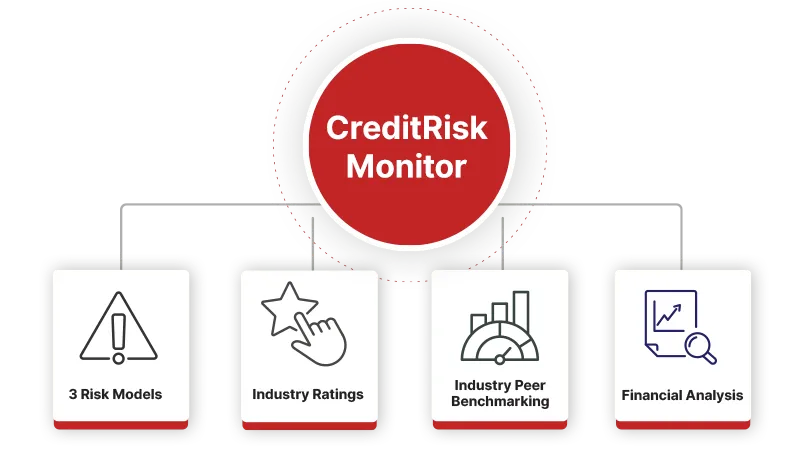
Key Benefits

Industry-leading risk accuracy
Combines advanced analytics, proprietary expert insight and a unique, transparent methodology to deliver the most accurate and complete picture of counterparty financial health available.
Transparent methodology
Uses three proprietary risk models, leading agency ratings, shared and verified financial data, crowdsourced intelligence, AI-driven automation, trade payment behavior, country credit ratings and expert financial analysis. This innovative approach sets the standard for credit risk management software.

3 Proprietary credit risk models
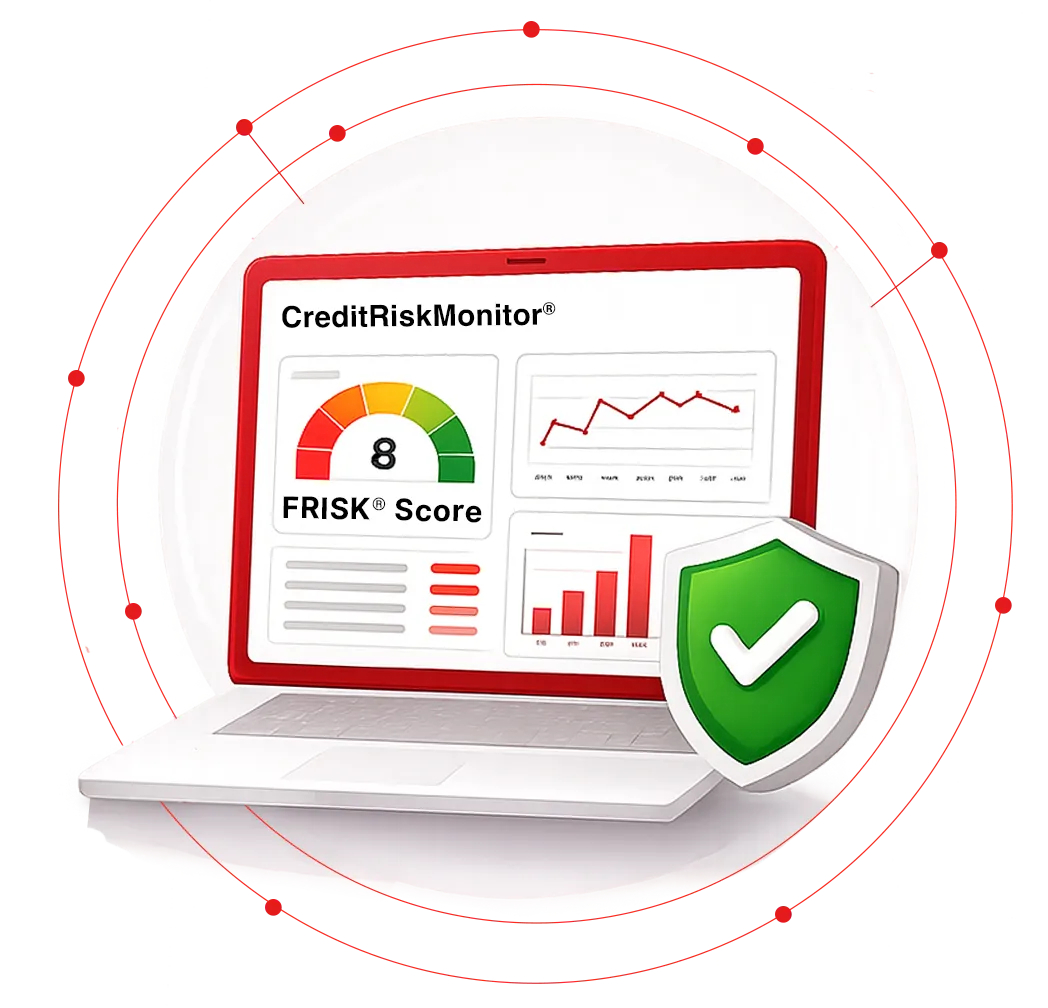
Our proprietary FRISK® Score, PAYCE® Score and FAST Rating continuously monitor public and private company financial risk. Use our models to stay ahead of counterparty financial stress and bankruptcy filings.
Why clients choose CreditRiskMonitor®
-
Early visibility into bankruptcy and financial distress
-
Innovative approach with multiple risk
models and ratings -
Deep financial analysis that delivers
insights other platforms miss

Powerful features for proactive risk management
Get the most complete picture of your risk exposure
CreditRiskMonitor® fills in the gaps left by internal systems and other business intelligence platforms.

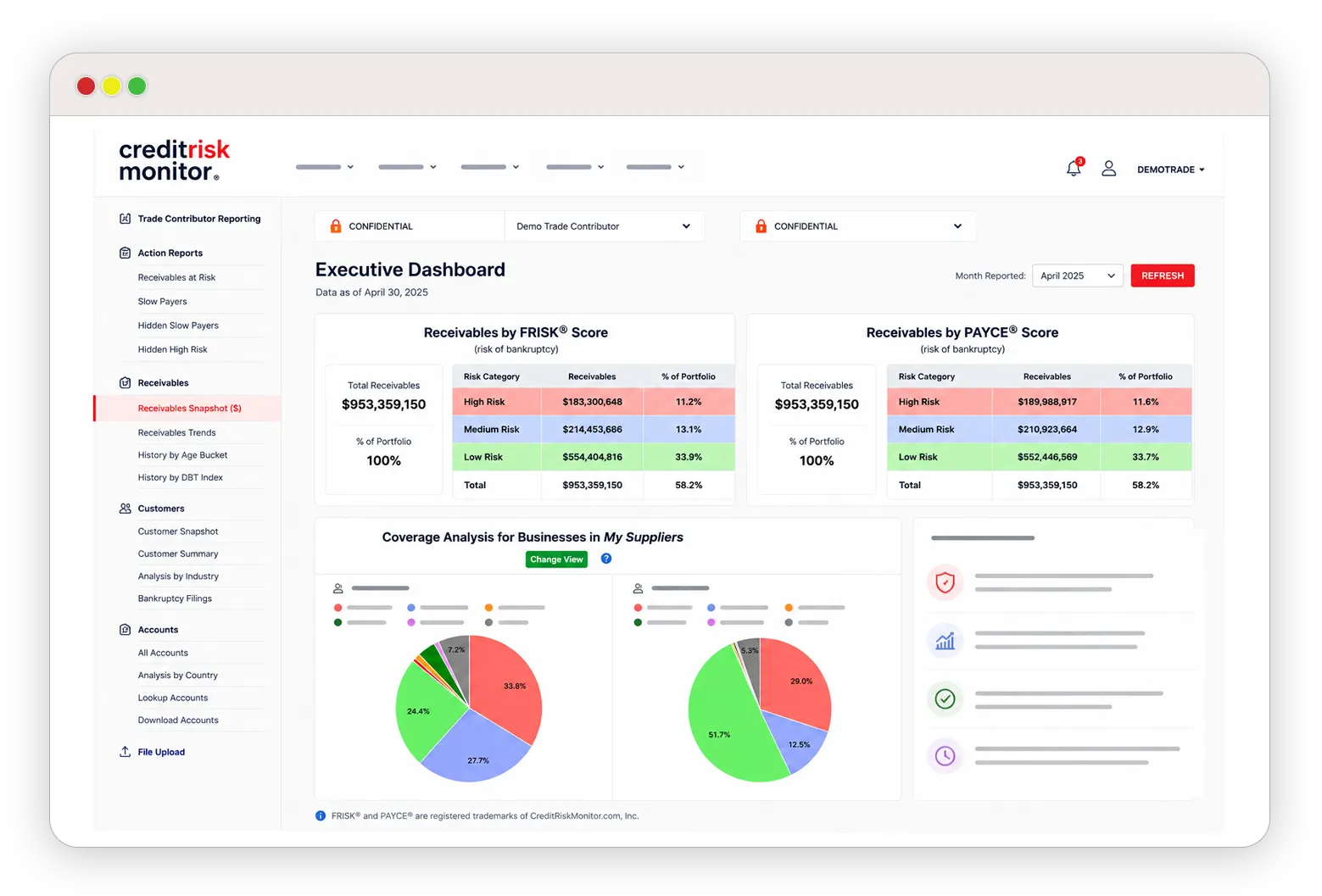
Executive Dashboard
Monitor portfolio health, risk trends and accounts receivable performance from a single, intuitive dashboard within our credit risk management software.
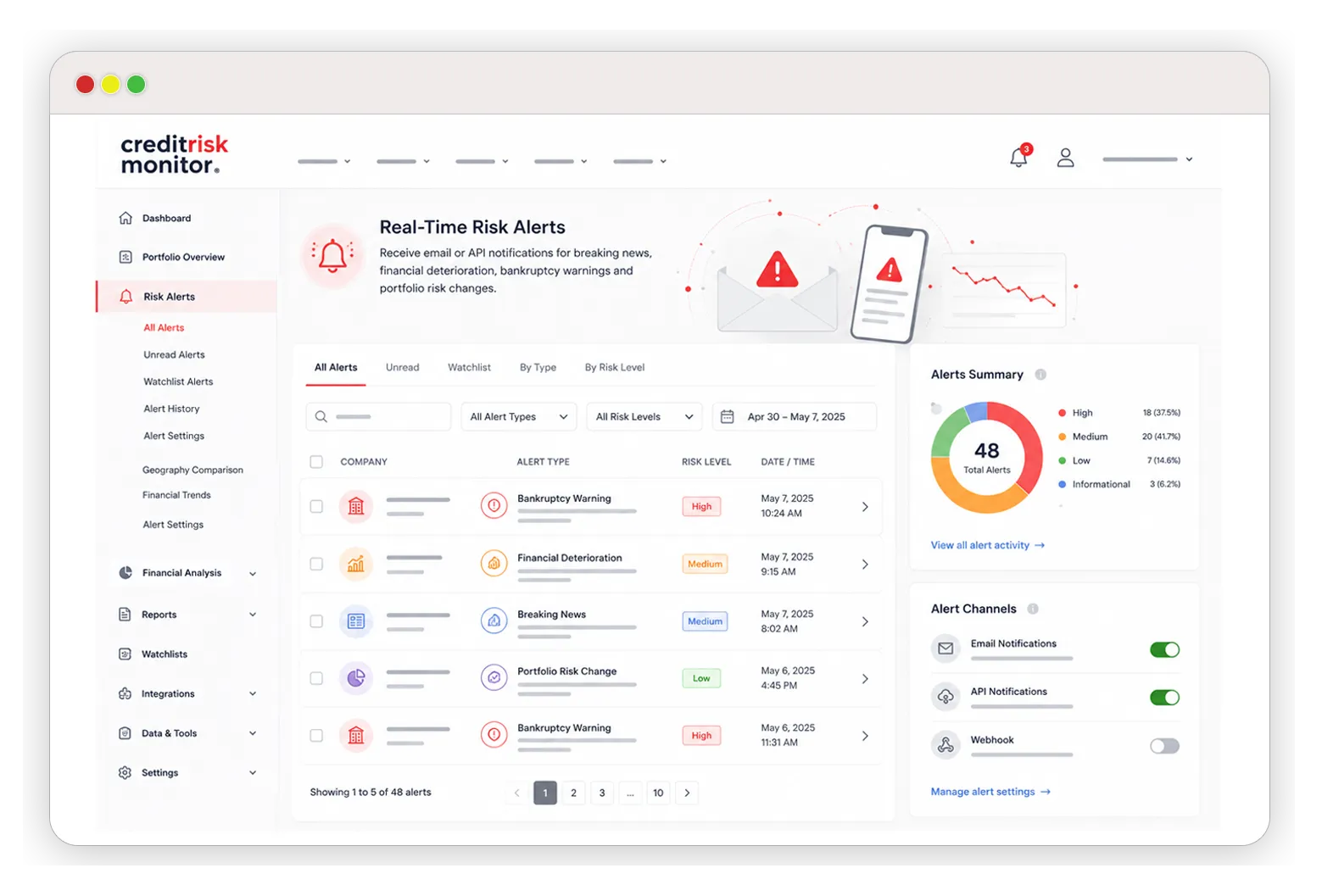
Real-Time Risk Alerts
Receive email or API notifications for breaking news, financial deterioration, bankruptcy warnings and portfolio risk changes.
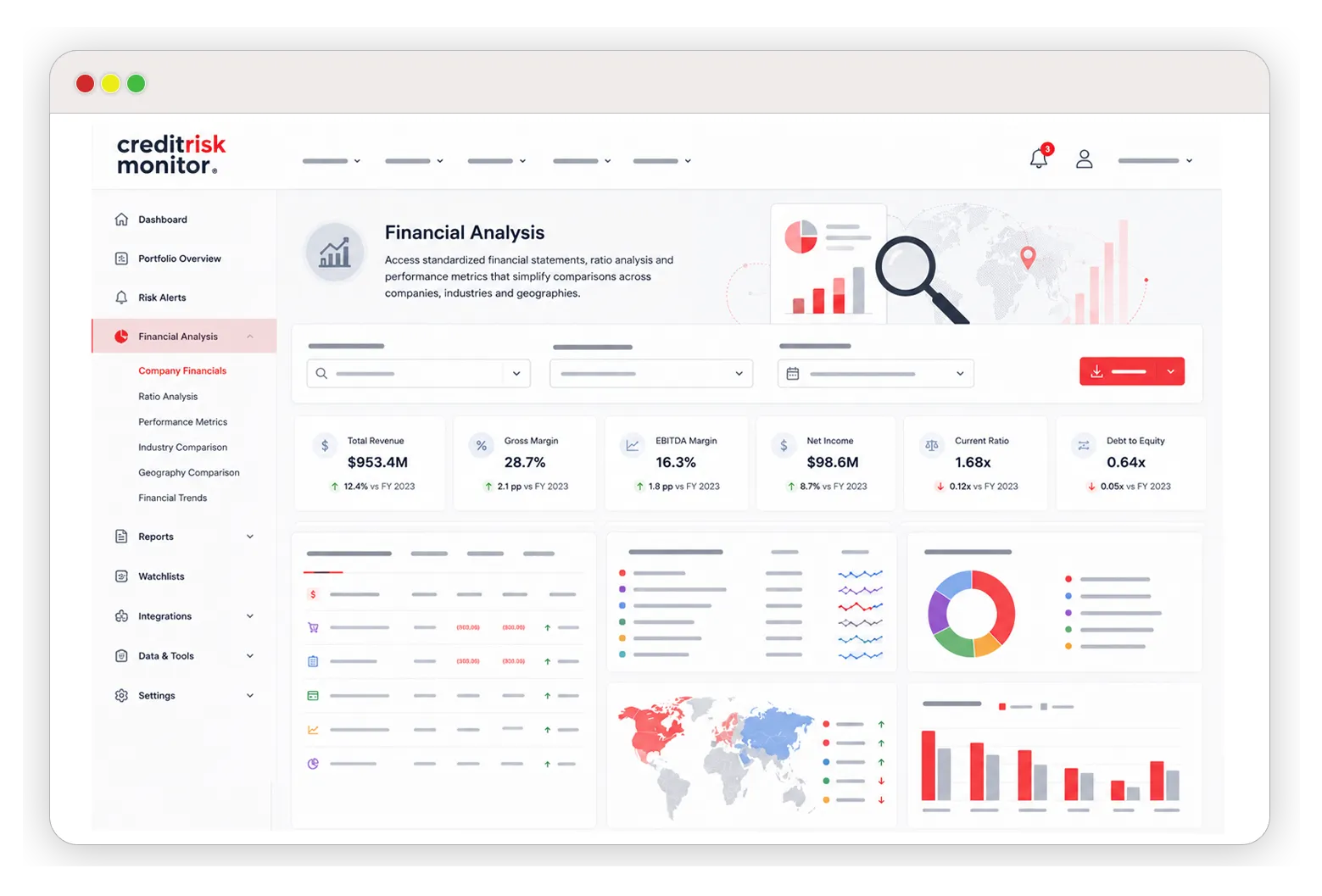
Financial Analysis
Access standardized financial statements, ratio analysis and performance metrics that simplify comparisons across companies, industries and geographies.
Effective insights designed for today’s risk environment
Corporate bankruptcies, economic uncertainty and rising debt levels continue to increase financial risk across every industry. CreditRiskMonitor® helps organizations respond proactively by identifying warning signs before they become financial losses.
Whether you’re monitoring a handful of strategic accounts or a global customer portfolio, our credit risk management software helps reduce bad debt, improve working capital and protect profitability.
Expand platform capabilities
Enhance your CreditRiskMonitor® subscription with these optional solutions:
Trade Contributor Program
Gain deeper insight into customer payment behavior through confidential trade receivables data.
International Private Company Risk Insights
Access financial risk intelligence on more than nine million private companies across Europe and Japan.
Confidential Financial Statements Solution
Obtain one-day financial assessments and FRISK® Scores for private companies that do not publicly disclose financial statements.
25+ Years of experience
Our seasoned team has been delivering innovative, reliable and scalable tech solutions to clients worldwide since 1999.
100+ Enthusiastic clients
Trusted by startups and Fortune 1000 companies for delivering high-quality, secure and scalable digital development solutions globally.
90+ Skilled professionals
A passionate team of developers, designers and specialists dedicated to crafting seamless and innovative digital solutions.
100% Client satisfaction
We take pride in long-term partnerships built on trust, transparency and consistently exceeding client expectations.
Frequently Asked Questions
Everything you need to know about how CreditRiskMonitor® works and how it delivers accurate, consistent risk assessment.
What makes CreditRiskMonitor different from other credit risk software providers?
CreditRiskMonitor focuses on delivering timely financial risk insights using a combination of public filings, proprietary analytics, and real-time monitoring. This allows teams to identify potential issues earlier and make more informed decisions.
How accurate are the risk alerts and insights?
Risk alerts are driven by continuously updated financial data sources and structured analysis models. While no system can predict outcomes with certainty, the platform is designed to surface meaningful signals as early as possible.
Can I monitor specific companies or accounts?
Yes, users can create custom watchlists to track specific companies, customers, or suppliers. This makes it easier to stay informed about emerging risks that directly impact your business.
How often is the data updated?
Data is updated on an ongoing basis, with many alerts and signals processed in near real time as new filings, events, or financial indicators become available.
Is CreditRiskMonitor® suitable for small teams or only large enterprises?
The platform is designed to support both small teams and large organizations. It scales depending on how many companies you want to monitor and how deeply you need to analyze risk.
How does this compare to traditional credit reports?
Traditional credit reports often rely on static or periodically updated data. CreditRiskMonitor® emphasizes continuous monitoring and early warning signals, helping users react faster to changes.
Can this help with supplier or customer risk management?
Yes, many organizations use the platform to monitor the financial health of suppliers and partners, helping reduce exposure to disruptions in the supply chain.
Do I need technical expertise to use the platform?
No, the interface is designed for business users. Dashboards and alerts are structured to be easy to understand without requiring advanced financial or technical knowledge.
How quickly can I get started?
Most users can begin monitoring companies and setting up watchlists shortly after onboarding, with minimal setup required.
Is there a trial or demo available?
Many teams start with a demo to understand how the credit risk analysis software fits their workflow. From there, access can be tailored based on specific needs.
What is credit risk management software?
Credit risk management software helps organizations evaluate the financial stability of customers, suppliers and other business partners before extending credit or entering into commercial relationships. It combines financial data, credit reports, predictive analytics and continuous monitoring to identify companies that may be at risk of financial distress or default.
Unlike manual credit reviews that rely on periodic financial statements, modern credit risk management software continuously monitors changes in a company’s financial condition and alerts users when risks emerge. This enables finance, credit and risk management teams to make faster, more informed decisions, reduce bad debt and protect cash flow.
How does credit risk analysis software work?
Credit risk management software collects and analyzes financial information from multiple sources to evaluate a company’s ability to meet its financial obligations. Depending on the solution, this may include audited financial statements, SEC filings, payment behavior, credit bureau data, public records, news, legal filings and predictive risk models.
The software transforms this information into risk scores, financial health assessments and automated alerts that help credit professionals identify deteriorating accounts before significant losses occur. Many platforms also integrate with ERP, CRM and accounts receivable systems to automate credit reviews and ongoing portfolio monitoring.
Why is credit risk assessment important?
Every business that extends credit assumes some level of financial risk. If a customer experiences financial difficulties or files for bankruptcy, unpaid invoices can directly affect profitability and cash flow.
Credit risk management helps organizations identify high-risk accounts before extending credit, establish appropriate credit limits and continuously monitor existing customers for signs of financial deterioration. Proactive credit risk management reduces bad debt, improves collections, protects working capital and enables companies to make more confident business decisions.
What information is used to evaluate a company’s credit risk?
Credit risk management software typically evaluates a combination of financial, operational and market information.
Common data sources include:
- Financial statements
- SEC filings
- Business credit reports
- Payment history
- Public records
- Bankruptcies and liens
- Court filings
- Industry trends
- Company ownership information
- News and adverse media
- Predictive financial risk models
Using multiple data sources provides a more complete picture of a company’s financial health than relying on a single credit score alone.
What is continuous credit monitoring?
Continuous credit monitoring is the ongoing evaluation of a company’s financial health after an initial credit decision has been made.
Instead of reviewing customers once a year, continuous monitoring automatically tracks important financial events such as declining financial performance, late filings, bankruptcy filings, credit rating changes, payment deterioration or significant corporate events. When meaningful changes occur, the system immediately notifies credit professionals so they can reassess exposure and take appropriate action. Automated credit systems can increase productivity by 30%.
Can credit risk management software predict business bankruptcies?
No software can predict every bankruptcy with complete certainty, but advanced credit risk management software can identify many of the financial warning signs that often precede business failure.
Predictive analytics evaluate trends in financial performance, liquidity, leverage, profitability, cash flow and other indicators that may signal increasing financial distress. Some platforms also incorporate machine learning and historical default models to estimate the probability of financial failure.
By identifying deteriorating companies months before bankruptcy occurs, organizations have more time to adjust credit limits, strengthen collections or reduce their financial exposure.
What are the benefits of credit risk management software?
Credit risk management software helps organizations make more informed credit decisions while reducing financial risk across their customer portfolio.
Key benefits include:
- Faster credit decisions
- Reduced bad debt
- Improved cash flow
- Continuous customer monitoring
- Early warning alerts
- More consistent credit policies
- Better credit limit management
- Automated risk assessments
- Improved regulatory compliance
- Greater visibility into portfolio risk
These capabilities help organizations reduce losses while improving operational efficiency and customer service.
How does credit risk management software improve accounts receivable performance?
Credit risk management software enables finance teams to identify higher-risk customers before invoices become seriously delinquent.
By continuously monitoring financial health and providing early warning alerts, organizations can adjust payment terms, reduce credit exposure or begin collections activities sooner. Better visibility into risk exposure also helps prioritize collection efforts and allocate resources more effectively.
The result is fewer bad debt write-offs, lower Days Sales Outstanding (DSO), improved cash flow and a healthier accounts receivable portfolio.
What should businesses look for in credit risk management software?
The best credit risk management software combines comprehensive financial data with predictive analytics and continuous monitoring.
When evaluating solutions, organizations should consider whether the software provides:
- Reliable financial information
- Predictive risk scoring
- Continuous monitoring and alerts
- Historical financial trends
- Public and private company coverage
- Automated workflows
- Portfolio reporting
- ERP and CRM integrations
- Customizable risk policies
- Global company coverage
Selecting software that provides early warning indicators—not just static credit reports—can significantly improve credit decision-making.
How often should businesses perform customer credit analysis?
Customer credit risk should be monitored continuously rather than reviewed only during onboarding or annual account reviews.
A company’s financial condition can change rapidly due to economic conditions, industry disruptions, management changes or unexpected business events. Ongoing monitoring enables organizations to detect meaningful changes as they occur instead of waiting until the next scheduled review.
Many organizations also perform formal credit reviews when customers request higher credit limits, payment performance changes significantly, financial statements become available or important corporate events occur. Continuous portfolio monitoring combined with periodic in-depth reviews provides the strongest protection against unexpected credit losses.
Learn more about our platforms
We get it. You have a few questions, but aren’t ready for a full platform demo. Set up a quick intro call with one of our specialists.